 MotoGP
Back to Home
MotoGP 5 min read time 0 viewsJul 26, 2026
The 2026 Yamaha MT Series: Master of Torque, Specs, and Real World Costs
A deep dive into the 2026 Yamaha MT lineup, detailing specs, segment battles, and the real-world financial realities of naked bike ownership.
The 2026 Yamaha MT Series: Does The Master of Torque Still Rule The Streets?
If you are wondering whether the 2026 Yamaha MT lineup still lives up to its "Master of Torque" reputation, the short answer is a massive yes. The naked motorcycle game has completely changed over the last two decades. We moved away from detuned supersport engines and entered an era of pure, brutal streetfighters built for immediate mid-range acceleration. The 2026 models, from the rev-happy MT-03 to the beastly 119-horsepower MT-09, deliver an absurd amount of street-legal adrenaline. However, this pure mechanical emotion comes with a heavy maintenance reality that will test your wallet just as much as your riding skills.
Let me tell you something straight from the garage. I have been watching the evolution of these bikes since the original MT-01 concept dropped way back in 1999. Back then, everyone was obsessed with inline-four top speed. Yamaha went the other way. They focused on "Kodo" (the Japanese concept of soul beat) and prioritized raw pulling power over chasing numbers on a dyno sheet. Today, this philosophy is the backbone of the hyper-naked segment.
When you twist the throttle on any modern MT bike, you are not just getting speed. You are getting instant gratification. But before you pull the trigger at the dealership, you need to understand what you are actually buying. If you want a deeper dive into the flagship model, I highly suggest you read my 2026 Yamaha MT-09 full review and spec breakdown to see exactly how this machine handles everyday traffic. The transition from the old era to the "Dark Side of Japan" aesthetics in 2014 was a masterstroke, and the 2026 lineup is the absolute peak of that engineering journey.

The Crossplane Concept: Why The CP2 and CP3 Engines Feel Different
You cannot talk about the modern MT series without geeking out slightly over the engine architecture. The secret sauce behind the punchy feel of the MT-07 and MT-09 is the Crossplane technology. In a regular inline engine, the pistons move in pairs, creating a ton of inertial mechanical noise. Yamaha spaces the crankpins differently to eliminate that noise, giving you a direct, almost telepathic connection between your right wrist and the rear tire. They call it "clean torque", and believe me, it is not just marketing jargon. You feel it in your bones every time you exit a corner.
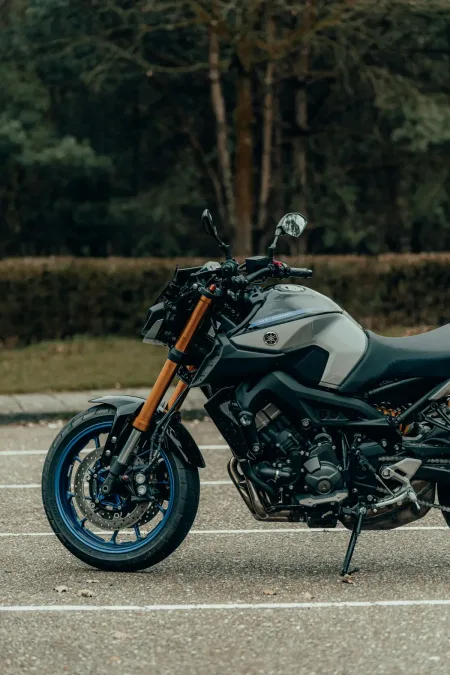
Let us look closely at the 2026 Yamaha MT-09. This bike rocks the famous CP3 engine, which is an 890cc inline-three with a 120-degree crankshaft. Because no two pistons are ever at a dead stop simultaneously, the power delivery is incredibly smooth yet violent when you want it to be. Add a highly aggressive acoustic tune from staggered intake funnels, and you get a bike that howls like a banshee at 10,000 rpm. Below, I break down the specs, translating what the factory manual says into what you actually feel on the asphalt.
Official Specs
Yamaha MT-09 (2026)
Engine & Performance
- Displacement 890 cc (CP3 Inline-Three) Street Reality: The perfect middle ground. It pulls hard from a stoplight without the terrifying top-end weight of a 1000cc literbike.
- Maximum Power 119 hp @ 10,000 rpm Street Reality: More than enough power to lose your license in second gear. It demands respect and throttle control.
- Maximum Torque 93 Nm (9.4 kgf.m) @ 7,000 rpm Street Reality: This is where the magic happens. You rarely need to downshift to pass cars on the highway.
Chassis & Electronics
- Electronic Suite 6-axis IMU, Traction Control, Slide Control Street Reality: The digital safety net that keeps you from high-siding when you get too confident on cold tires.
- Transmission 6-speed with Bi-directional Quickshifter Street Reality: Clutchless shifting makes you feel like a MotoGP racer on your morning commute. Absolutely addictive.

The Naked Battles: MT-03 vs Z400 and MT-07 vs CB650R
Let us talk about the trenches of the motorcycle market. If you are stepping up from a small commuter bike, the 300cc to 400cc entry-level segment is brutal. The 2026 Yamaha MT-03 is often called the "Baby Beast", pushing 41.3 horsepower from its high-revving 321cc parallel-twin. It boasts inverted KYB forks and Y-Connect Bluetooth integration, making it a premium choice. However, it faces serious competition. The Honda CB300F Twister is the strictly rational choice for those wanting cheap parts and amazing fuel economy. On the other end, the Kawasaki Z400 remains the performance king with its 45 horsepower.
In my opinion, the MT-03 hits the sweet spot. It feels like a bigger bike, handles beautifully on twisty roads, and gives you that premium aesthetic. But if you are ready for the middleweight class, the game changes entirely. The 2026 MT-07 with its 689cc CP2 engine (a 270-degree parallel twin) is an absolute riot. It produces around 74 horsepower and kicks like a mule right off the line.
When you compare the MT-07 to the Kawasaki Z650 or the Honda CB650R, you see vastly different philosophies. The Z650 is pragmatic and highly predictable. The CB650R features a gorgeous inline-four that screams at the top of the rev range but requires you to wring its neck to find the power. The MT-07, by contrast, gives you all its grunt instantly. It is built for urban hooliganism, tight corners, and leaving traffic behind before they even realize the light turned green.

The True Costs of Ownership: Maintenance, IPVA, and Garage Realities
Now we arrive at the painful part of the conversation. Buying a premium naked bike is just the entry ticket. Keeping it running safely and legally is where many riders get a rude awakening. If you live in Santa Catarina, you actually have a massive bureaucratic advantage. The state government here in SC has set the 2026 IPVA rate for motorcycles at an incredibly low 1% of the FIPE table value. This is a game changer compared to other regions. If you buy a 2026 MT-09 for around R$ 65,000, your base IPVA is just R$ 650. If you pay it in a single quota, you get a 5% discount, bringing it down to R$ 617.50. For an MT-03 valued at roughly R$ 34,000, the discounted tax is merely R$ 323.
However, the money you save on taxes in Santa Catarina will quickly vanish at the gas pump and the mechanic shop. The MT series is notoriously demanding when it comes to consumables. The MT-03 loves to drink fuel, averaging around 20 to 23 km/l in the city. If you commute daily, your fuel bills will skyrocket. Then you have to factor in tires. The massive torque of these CP2 and CP3 engines chews through rear rubber aggressively. Expect to spend at least R$ 1,000 on a good set of tires every 12,000 to 20,000 kilometers.
Yamaha offers a Fixed Price Revision program for bikes up to 689cc, which provides some peace of mind. The first two revisions have free labor, but once you hit the 10,000 km mark, a standard dealership service will easily set you back over R$ 1,000. Add comprehensive insurance into the mix (which is non-negotiable in my book), and the monthly math becomes clear. You simply cannot maintain an MT-03 safely on a minimum wage. Financial reality dictates you need a disposable income of at least R$ 4,000 a month to enjoy these machines without losing sleep over your credit card bill. The "Master of Torque" delivers an unmatched thrill, but you must be prepared to pay the toll.
Tags:MotoGPyamaha mt-09 2026yamaha mt-03 2026mt-07 vs z650mt-03 vs z400cp3 engine crossplaneyamaha maintenance costs
Recommended Posts
Comentários (0)
Participe da discussão
Faça login ou cadastre-se rapidamente para enviar seu comentário. É simples e leva menos de 1 minuto!
Nenhum comentário por enquanto. Seja o primeiro a opinar!